
Anthropic推出Cowork:非技术用户也能用Claude操作本地文件

摘要
Anthropic发布Cowork,一个面向非技术用户的AI代理功能,允许Claude读取、编辑和创建本地文件夹中的文件。该功能基于Claude Code构建,团队仅用约一周半时间开发完成,部分代码由Claude Code自身编写。
背景解释
Cowork标志着AI代理从开发者工具向主流用户扩展的关键转折。与微软Copilot等竞品不同,Anthropic通过沙盒化文件夹访问和连接器集成,在实用性与安全性间寻求平衡。该功能展示了AI自我加速开发的潜力——用AI工具构建AI产品,可能加剧AI实验室之间的能力差距。用户需注意文件误删和提示注入风险。
原文译文
以下为抓取到的原文内容译文,已统一为站内阅读格式。
Featured
3:30 am, PT, January 12, 2026

Credit: VentureBeat made with Midjourney
[Add to Google Preferred Source](https://www.google.com/preferences/source?q=venturebeat.com "Add to Google Preferred Source")
AnthropicreleasedCoworkon Monday, a new AI agent capability that extends the power of its wildly successfulClaude Codetool to non-technical users — and according to company insiders, the team built the entire feature in approximately a week and a half, largely using Claude Code itself.
The launch marks a major inflection point in the race to deliver practical AI agents to mainstream users, positioning Anthropic to compete not just withOpenAIandGooglein conversational AI, but withMicrosoft's Copilotin the burgeoning market for AI-powered productivity tools.
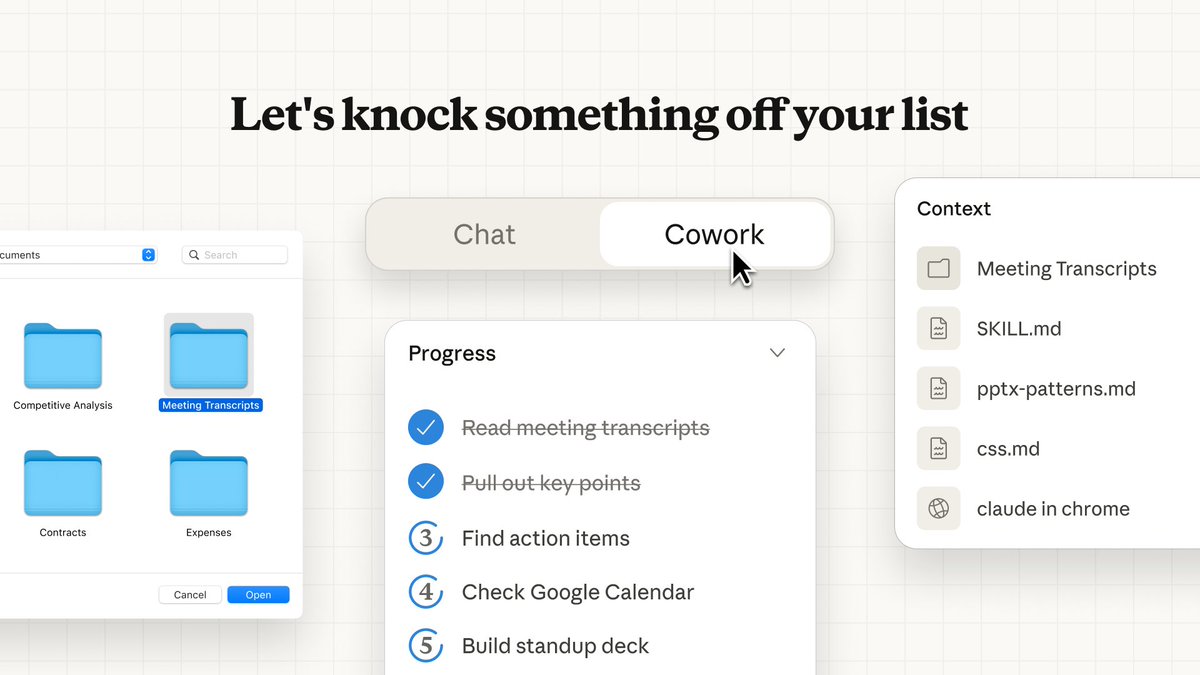
"Cowork lets you complete non-technical tasks much like how developers use Claude Code," thecompany announcedvia its official Claude account on X. The feature arrives as a research preview available exclusively toClaude Max subscribers— Anthropic's power-user tier priced between $100 and $200 per month — through the macOS desktop application.
For the past year, the industry narrative has focused on large language models that can write poetry or debug code. WithCowork, Anthropic is betting that the real enterprise value lies in an AI that can open a folder, read a messy pile of receipts, and generate a structured expense report without human hand-holding.
Twitter Embed

Claude\ \ 
·
Introducing Cowork: Claude Code for the rest of your work.
Cowork lets you complete non-technical tasks much like how developers use Claude Code.
Copy link
How developers using a coding tool for vacation research inspired Anthropic's latest product
The genesis ofCoworklies in Anthropic's recent success with the developer community. In late 2024, the company releasedClaude Code, a terminal-based tool that allowed software engineers to automate rote programming tasks. The tool was a hit, but Anthropic noticed a peculiar trend: users were forcing the coding tool to perform non-coding labor.
According toBoris Cherny, an engineer at Anthropic, the company observed users deploying the developer tool for an unexpectedly diverse array of tasks.
Twitter Embed

·
Since we launched Claude Code, we saw people using it for all sorts of non-coding work: doing vacation research, building slide decks, cleaning up your email, cancelling subscriptions, recovering wedding photos from a hard drive, monitoring plant growth, controlling your oven.Show more

Claude

@claudeai
Introducing Cowork: Claude Code for the rest of your work.
Cowork lets you complete non-technical tasks much like how developers use Claude Code.

Copy link
"Since we launched Claude Code, we saw people using it for all sorts of non-coding work: doing vacation research, building slide decks, cleaning up your email, cancelling subscriptions, recovering wedding photos from a hard drive, monitoring plant growth, controlling your oven," Cherny wrote on X. "These use cases are diverse and surprising — the reason is that the underlying Claude Agent is the best agent, and Opus 4.5 is the best model."
Recognizing this shadow usage, Anthropic effectively stripped the command-line complexity from their developer tool to create a consumer-friendly interface. In its blog post announcing the feature,Anthropic explainedthat developers "quickly began using it for almost everything else," which "prompted us to build Cowork: a simpler way for anyone — not just developers — to work with Claude in the very same way."
Inside the folder-based architecture that lets Claude read, edit, and create files on your computer
Unlike a standard chat interface where a user pastes text for analysis,Coworkrequires a different level of trust and access. Users designate a specific folder on their local machine that Claude can access. Within that sandbox, the AI agent can read existing files, modify them, or create entirely new ones.
Anthropic offers several illustrative examples: reorganizing a cluttered downloads folder by sorting and intelligently renaming each file, generating a spreadsheet of expenses from a collection of receipt screenshots, or drafting a report from scattered notes across multiple documents.
"In Cowork, you give Claude access to a folder on your computer. Claude can then read, edit, or create files in that folder,"the company explainedon X. "Try it to create a spreadsheet from a pile of screenshots, or produce a first draft from scattered notes."
Twitter Embed
Visit this post on XVisit this post on X

Claude\ \ 
·
·
Introducing Cowork: Claude Code for the rest of your work.
Cowork lets you complete non-technical tasks much like how developers use Claude Code.

Claude\ \ 
·
In Cowork, you give Claude access to a folder on your computer. Claude can then read, edit, or create files in that folder.
Try it to create a spreadsheet from a pile of screenshots, or produce a first draft from scattered notes.

Copy link
The architecture relies on what is known as an "agentic loop." When a user assigns a task, the AI does not merely generate a text response. Instead, it formulates a plan, executes steps in parallel, checks its own work, and asks for clarification if it hits a roadblock. Users can queue multiple tasks and let Claude process them simultaneously — a workflow Anthropic describes as feeling "much less like a back-and-forth and much more like leaving messages for a coworker."
The system is built on Anthropic'sClaude Agent SDK, meaning it shares the same underlying architecture as Claude Code. Anthropic notes that Cowork "can take on many of the same tasks that Claude Code can handle, but in a more approachable form for non-coding tasks."
The recursive loop where AI builds AI: Claude Code reportedly wrote much of Claude Cowork
Perhaps the most remarkable detail surrounding Cowork's launch is the speed at which the tool was reportedly built — highlighting a recursive feedback loop where AI tools are being used to build better AI tools.
During a livestream hosted by Dan Shipper, Felix Rieseberg, an Anthropic employee, confirmed thatthe teambuilt Cowork in approximately a week and a half.
Alex Volkov, who covers AI developments, expressed surprise at the timeline: "Holy shit Anthropic built 'Cowork' in the last... week and a half?!"
Twitter Embed

Alex Volkov @ AI Engineer\ \ 
·
holy shit Anthropic built "Cowork" in the last... week and a half?!
Confirmed by Anthropic employee@felixriesebergon@danshipper's live stream
I wonder how much of this was Claude Code

Claude
@claudeai
Introducing Cowork: Claude Code for the rest of your work.
Cowork lets you complete non-technical tasks much like how developers use Claude Code.

Copy link
This prompted immediate speculation about how much of Cowork was itself built by Claude Code.Simon Smith, EVP of Generative AI at Klick Health, put it bluntly on X: "Claude Code wrote all of Claude Cowork. Can we all agree that we're in at least somewhat of a recursive improvement loop here?"
The implication is profound: Anthropic's AI coding agent may have substantially contributed to building its own non-technical sibling product. If true, this is one of the most visible examples yet of AI systems being used to accelerate their own development and expansion — a strategy that could widen the gap between AI labs that successfully deploy their own agents internally and those that do not.
Connectors, browser automation, and skills extend Cowork's reach beyond the local file system
Cowork doesn't operate in isolation. The feature integrates with Anthropic's existing ecosystem of connectors — tools that linkClaudeto external information sources and services such asAsana,Notion,PayPal, and other supported partners. Users who have configured these connections in the standard Claude interface can leverage them within Cowork sessions.
Additionally, Cowork can pair withClaude in Chrome, Anthropic's browser extension, to execute tasks requiring web access. This combination allows the agent to navigate websites, click buttons, fill forms, and extract information from the internet — all while operating from the desktop application.
"Cowork includes a number of novel UX and safety features that we think make the product really special,"Cherny explained, highlighting "a built-in VM [virtual machine] for isolation, out of the box support for browser automation, support for all your claude.ai data connectors, asking you for clarification when it's unsure."
Anthropichas also introduced an initial set of "skills" specifically designed for Cowork that enhance Claude's ability to create documents, presentations, and other files. These build on theSkills for Claudeframework the company announced in October, which provides specialized instruction sets Claude can load for particular types of tasks.
Why Anthropic is warning users that its own AI agent could delete their files
The transition from a chatbot that suggests edits to an agent that makes edits introduces significant risk. An AI that can organize files can, theoretically, delete them.
In a notable display of transparency, Anthropic devoted considerable space in its announcement towarning users about Cowork's potential dangers— an unusual approach for a product launch.
The company explicitly acknowledges that Claude "can take potentially destructive actions (such as deleting local files) if it's instructed to." Because Claude might occasionally misinterpret instructions, Anthropic urges users to provide "very clear guidance" about sensitive operations.
More concerning is the risk of prompt injection attacks — a technique where malicious actors embed hidden instructions in content Claude might encounter online, potentially causing the agent to bypass safeguards or take harmful actions.
"We've built sophisticated defenses against prompt injections," Anthropic wrote, "but agent safety — that is, the task of securing Claude's real-world actions — is still an active area of development in the industry."
The company characterized these risks as inherent to the current state of AI agent technology rather than unique to Cowork. "These risks aren't new with Cowork, but it might be the first time you're using a more advanced tool that moves beyond a simple conversation," the announcement notes.
Anthropic's desktop agent strategy sets up a direct challenge to Microsoft Copilot
The launch ofCoworkplaces Anthropic in direct competition withMicrosoft, which has spent years attempting to integrate itsCopilot AIinto the fabric of the Windows operating system with mixed adoption results.
However, Anthropic's approach differs in its isolation. By confining the agent to specific folders and requiring explicit connectors, they are attempting to strike a balance between the utility of an OS-level agent and the security of a sandboxed application.
What distinguishes Anthropic's approach is its bottom-up evolution. Rather than designing an AI assistant and retrofitting agent capabilities, Anthropic built a powerful coding agent first —Claude Code— and is now abstracting its capabilities for broader audiences. This technical lineage may give Cowork more robust agentic behavior from the start.
Claude Code has generated significant enthusiasm among developers since its initial launch asa command-line tool in late 2024. The company expanded access with aweb interfacein October 2025, followed by aSlack integrationin December. Cowork is the next logical step: bringing the same agentic architecture to users who may never touch a terminal.
Who can access Cowork now, and what's coming next for Windows and other platforms
For now, Cowork remains exclusive toClaude Max subscribersusing the macOS desktop application. Users on other subscription tiers — Free, Pro, Team, or Enterprise — can join a waitlist for future access.
Anthropic has signaled clear intentions to expand the feature's reach. The blog post explicitly mentions plans to add cross-device sync and bring Cowork to Windows as the company learns from the research preview.
Cherny set expectations appropriately, describing the product as "early and raw, similar to what Claude Code felt like when it first launched."
To accessCowork, Max subscribers can download or update the Claude macOS app and click on "Cowork" in the sidebar.
The real question facing enterprise AI adoption
For technical decision-makers, the implications of Cowork extend beyond any single product launch. The bottleneck for AI adoption is shifting — no longer is model intelligence the limiting factor, but rather workflow integration and user trust.
Anthropic's goal, as the company puts it, is to make working with Claude feel less like operating a tool and more like delegating to a colleague. Whether mainstream users are ready to hand over folder access to an AI that might misinterpret their instructions remains an open question.
But the speed of Cowork's development — a major feature built in ten days, possibly by the company's own AI — previews a future where the capabilities of these systems compound faster than organizations can evaluate them.
The chatbot has learned to use a file manager. What it learns to use next is anyone's guess.
More

The release, which Anthropic describes as "the most agentic Sonnet model yet," makes Sonnet 5 the default model for users on Anthropic's Free and Pro plans, while also making it available to Max, Team, and Enterprise customers. IntroductoryAPI pricingis set at $2 per million input tokens and $10 per million output tokens through August 31, after which it rises to $3 and $15 respectively — still well below the $5 input and $25 output pricing of Anthropic's top-of-the-line Opus 4.8.
Michael NuñezJune 30, 2026

The first model in Google's Omni family lets teams generate, revise and edit video through plain-language instructions. It can replace multi-tool pipelines that used to require a film crew, an editor and several rounds of revision.
Sam WitteveenJune 30, 2026

By lowering the fiscal barrier to high-frequency image generation, Google is making a direct play to lock enterprise developers into its commercial platform ecosystem.
Carl FranzenJune 30, 2026

By registering the LongCat-2.0 repository under the open-source MIT License, Meituan positions the architecture with maximum legal flexibility for enterprise integration.
Carl FranzenJune 30, 2026

Sol and Terra set new high benchmark scores, while Luna performs near GPT-5.5 levels on several tests despite being positioned as the fastest and lowest-cost model
Carl FranzenJune 26, 2026

LFM2.5-230M proves that while 3-billion-parameter models like VibeThinker are solving advanced calculus, a 230-million-parameter model is the superior, highly optimized choice for executing structured tool calls and keeping agentic pipelines running
Carl FranzenJune 25, 2026

OpenAI is moving away from models that require heavy hand-holding and toward systems that can better infer the user’s goal, preserve constraints and adapt across multiple turns.
Carl FranzenJune 25, 2026

The model supports 170 languages across 10 language groups, accepts PDF, DOC, PPT, and OpenDocument formats, and can be deployed as a single container on an organization's own infrastructure — a capability Mistral is positioning directly at enterprises in regulated industries that cannot route sensitive documents through U.S.-jurisdiction cloud APIs.
Michael NuñezJune 24, 2026

Real environments can't inject edge cases on demand. Alibaba built a simulator that can — and it made agents better.
Sean Michael KernerJune 24, 2026

Because Krea relinquishes centralized control over the downstream deployment of its open weights, the contract legally binds deployers to enforce content moderation protocols at the infrastructure layer.
Carl FranzenJune 23, 2026

The product, available today in beta forClaude EnterpriseandTeamcustomers, replaces Anthropic's existing Claude in Slack app and represents the company's most aggressive move yet to colonize the enterprise collaboration layer — the place where decisions get made, work gets assigned, and institutional knowledge accumulates in real time.
Michael NuñezJune 23, 2026

The release arrives at a moment of remarkable upheaval in the AI video generation market — and Alibaba appears keenly aware of the timing. OpenAIdiscontinued Soraafter it proved financially unsustainable. ByteDanceindefinitely shelvedthe international rollout of Seedance 2.0 following a barrage of copyright complaints from Hollywood studios. For enterprise procurement teams that had been evaluating or integrating those tools into marketing, advertising, and content production workflows, the competitive landscape has contracted sharply in a matter of months.
Michael NuñezJune 22, 2026
Twitter Widget Iframe
来源地区
United States
热度分
89
分类
研究进展
语言
en