
谷歌I/O 2026:开启科学发现新纪元

摘要
谷歌在I/O 2026大会上展示了其研究部门的最新成果,涵盖人工智能、量子计算等领域,旨在推动科学发现的新时代。
背景解释
谷歌I/O大会是科技界的重要活动,今年谷歌研究部门展示了多项前沿技术,这些技术有望加速科学发现,对普通用户而言,意味着未来可能享受到更智能的服务和更高效的问题解决方案。
原文译文
以下为抓取到的原文内容译文,已统一为站内阅读格式。
A New Era of Discovery: Google Research at I/O 2026
May 28, 2026
Yossi Matias, Vice President, Google & GM, Google Research
At Google I/O 2026 last week, Google teams showcased our most advanced technologies for users, developers and researchers. Here are some highlights from Google Research this year, often tapping into years-long efforts to realize the magic cycle of research.
Quick links
- Share
- [Share on Twitter](https://twitter.com/intent/tweet?text=https%3A//research.google/blog/a-new-era-of-innovation-google-research-at-io-2026/ "Share on Twitter")
- [Share on Facebook](https://www.facebook.com/sharer/sharer.php?u=https%3A//research.google/blog/a-new-era-of-innovation-google-research-at-io-2026/ "Share on Facebook")
- [Share on LinkedIn](https://www.linkedin.com/shareArticle?url=https%3A//research.google/blog/a-new-era-of-innovation-google-research-at-io-2026/&mini=true "Share on LinkedIn")
- [Send via Email](mailto:name@example.com?subject=Check%20out%20this%20site&body=Check%20out%20https%3A//research.google/blog/a-new-era-of-innovation-google-research-at-io-2026/ "Send via Email")
- Copy link
×
This year’s breakthroughs atGoogle I/Oreflect a new bold agentic era. With models that are more powerful than ever and an agentic coding platform, we’re making Google products substantially more helpful for everyone while transforming how researchers tackle the most pressing scientific and societal challenges. As research translates into tangible, real-world impact, we’re turning AI and technology into an amplifier of human ingenuity.
Here are a few key highlights from Google Research, done in close collaboration with many teams across Google and global partners.
Towards a new era of scientific discovery
AI is enabling a new era of scientific discovery. Google is building advanced AI-based tools designed to accelerate progress for the global scientific community. Our foundational technology is empowering researchers worldwide to drive breakthroughs across domains using the scientific method from hypothesis generation to computational experimentation. At I/O, we announcedGemini for Sciencewhich is built with our foundational research, including Empirical Research Assistance (ERA) and Co-Scientist — both published in _Nature_ last week.
Empirical Research Assistance(ERA) is a research coding system developed to help scientists write expert-level empirical software. Last week’s ERApublicationin _Nature_ followed months ofcollaborationwith academic partners to explore the system’s real-world applications. ERA has helpedaccelerate discoveriesfrom neuroscience to cosmology. Our latest results include predictinghospital admissions for respiratory illnessesand forecastingseasonal runoffacross California's river basins. These are available in our newGitHub directory. They signal the power of AI to unlock deeper insights with compute and accelerate discovery.
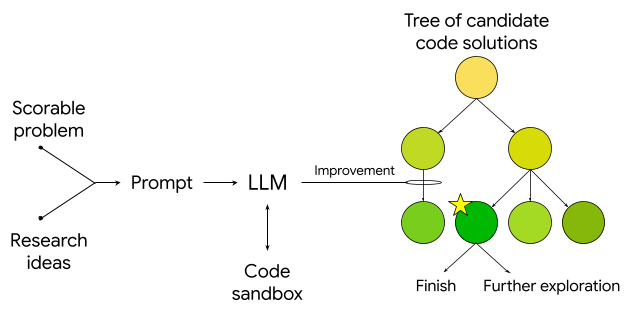
_Given a well-defined problem and a scoring system, Empirical Research Assistance (ERA) acts as a code-optimizing research engine. ERA proposes new concepts, writes code and evaluates the results. It then searches and iterates through thousands of code variants, using tree search to optimize performance._
Co-Scientistis a multi-agent system based on Gemini which works as a collaborative AI partner. Our foundational research on Co-Scientist waspublishedlast week in _Nature_ along with abloghighlighting testimonials from researchers. Our previous research andvalidation00973-0)papersdemonstrate how researchers are using Co-Scientist to tackle some of the most pressing scientific challenges, fromantimicrobial resistance00973-0) toplant immunityandliver fibrosis.
play silent looping videopause silent looping video
unmute videomute video
_An overview of the Co-scientist. It uses a coalition of specialized agents who iteratively generate, evaluate, and refine hypotheses._
Gemini for Scienceis a suite ofexperimental toolsdesigned to expand the scale and precision of scientific exploration — developed in close collaboration with teams from Google Cloud, Google DeepMind and Google Labs. One of the new tools in Gemini for Science,Computational Discovery, is an agentic research engine built with ERA andAlphaEvolve. The Computational Discovery prototype generates and scores thousands of code variations in parallel, enabling scientists to rapidly test multiple hypotheses and novel modeling approaches that would take months to explore manually.
With millions of papers published annually, synthesizing all the scientific literature has become a monumental challenge. Another new tool,Hypothesis Generation, was built using Co-Scientist. It aims to bridge this gap by collaborating with scientists to define a research challenge and running a multi-agent “idea tournament” to generate, debate and evaluate hypotheses. To ensure scientific rigor, claims are supported by clickable citations.
Gemini for Science also featuresLiterature Insights, built withNotebookLM, which helps synthesize findings across scientific literature and structure the results. Plus, anyone engaged in agentic coding on platforms likeGoogle Antigravitycould benefit from theScience Skills, a collection of agent skills that automatically allow researchers to perform complex workflows like structural bioinformatics and genomic analyses in minutes rather than hours.
We are gradually opening access to these tools and partnering with the global scientific community to responsibly advance science. To register your interest, visitlabs.google/science.
As part of our broader efforts to work with the ecosystem and foster access to our latest experiments, we’re also piloting tools for agentic peer review and scientific validation. Leading scientific conferences like ICML, STOC and NeurIPS are exploring ourPaper Assistant Tool(PAT). Across these venues, PAT reviewed over 10,000 papers in an experimental capacity — helping many authors identify critical theoretical gaps or run entirely new experiments based on the AI tool's feedback.
We’re alsoaccelerating mathematical and scientific discovery with Gemini Deep Thinkwith advanced agentic reasoning. In collaboration with mathematicians, physicists, and computer scientists, werecently solvedexpert-level open research problems, including previously unsolved deadlocks in networks puzzles, settling a decade-old optimization conjecture, explaining machine learning optimization anomalies, upgrading economic theory for auctions, and resolving physics singularities in cosmic strings.
In the hands of scientists and researchers, these new types of AI based technologies could change how research is done and catalyze a new era of discoveries.
Advancing Health with AI
AI can be instrumental in helping people live longer, healthier lives. For years, we’ve been advancing AI research to address healthcare challenges, working closely with healthcare providers, scientists, public officials and academics to bringour clinical research to real-world care settingsand ensure that our innovations are safe and helpful.
One area we’ve been researching is how AI can best support people throughout their health and wellness journeys, from learning about symptoms and preparing for a doctor’s visit, to making sense of their medical records — a journey that starts before people ever see a doctor and extends long after. Our foundational research is enabling the newGoogle Health appand theGoogle Health Coach. Last week, we began the rollout of Google Health app to all existing Fitbit users, enabling eligible users to have personalized, holistic, adaptive coaching.
This builds on our multi-year research effort, including research on how apersonal health LLMcould help withsleep and fitness. Our latest research includesSymptom AI, an investigational tool designed to study how AI can help reason about conversational data salient to a user’s symptoms. In a randomized consented research study via the Fitbit app, 13,917 participants interacted with experimental AI agents, capturing real world diverse communication styles and a realistic distribution of illnesses. In a blind comparison on a cohort of study participants, independent clinicians reviewed the same conversations and preferred Symptom AI’s differential diagnoses about twice as often as those from other clinicians. In ourPlan for Carepilot research study, we examined how 1,779 participants used our system to prepare for their doctor's visit. When compared with baseline models, 15% more users felt better prepared and 13% more users felt confident that they could make the most of their visit. In ourPersonal Health Record(PHR) research, we evaluated the impact of PHR data in model context on answer quality and found that both auto-raters and clinicians judged the AI responses to be significantly more helpful.
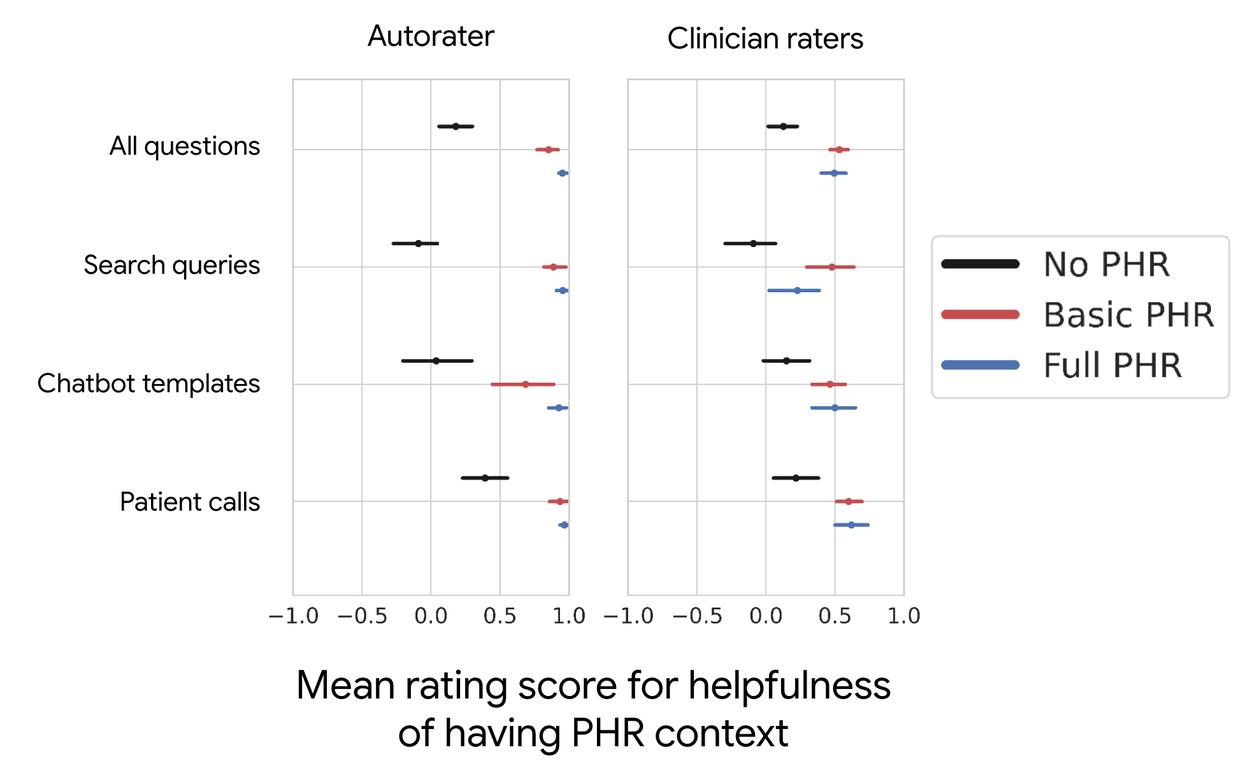
_Results from AI and clinician raters for helpfulness of AI responses when provided PHR context. Note that the raters (both AI and clinicians) are ‘oracles’ with access to the simulated user’s PHR context; in other words these oracles know the simulated user’s historical health context and can use that information to assess the AI response._
Another significant research effort is around the potential of AI in clinical settings. In two previous _Nature_ publications, we showed howAMIE— a research multi-agent system developed by Google Research and Google DeepMind — caninterpretandreasonabout complex cases and medical conversational data. In new researchpublishedlast week in _Nature Medicine_, we showcase its capabilities across multimodal data, including medical histories, lab results, and complex medical images. To evaluate the utility of the system in realistic settings, we’recollaboratingwithBeth Israel Deaconess Medical Centerto test how the system can help reduce the burden of real-time history-taking before a patient’s visit. We’ve also partnered withIncluded Healthto launch afirst-of-its-kind, national-scale study to evaluate AI-driven telehealth care.
Advancing healthcare is a global effort. We’re empowering the global healthcare developer ecosystem withMedGemma, part of ourHealth AI Developer Foundationssuite of open-weight foundation models for developers to build upon. MedGemma is specialized for multimodal medical text, clinical reasoning and imaging comprehension. Alongside it,MedASRprovides specialized medical audio capabilities. These models are powering applications with a wide range of use cases, helping to democratize access to quality care. MedGemma now has more than 5M downloads to date.
Coralboard for energy-efficient edge applications
We’re developing platforms and tools to help the hardware manufacturer ecosystem develop efficient edge applications.Coral NPUis an ML accelerator core that we developed for energy-efficient AI for edge applications like wearables and sensors. Based on open hardware, in partnership with deep silicon providers, this validated, open-source IP is available for commercial silicon integration, helping to create a standard architecture that accelerates the edge AI ecosystem.
At I/O last week, we launched the firstCoralboard from Synaptics, designed for AI and ML engineers as well as equipment manufacturers to rapidly prototype and build devices. The board features theGemma 3 270Mopen model and offers a rich set of hardware interfaces, including camera and display support, microphone inputs, and optional Wi-Fi / Bluetooth connectivity. Synaptics has invested in taking these solutions to market, bringing together the balance of power and performance from Coral with their Devboard intelligence.
The power of this industry-first implementation was illustrated in a unique pre-show experience: Coralboard was deployed to the Monterey Bay Aquarium for live on-device image detection of jellyfish and the movements were used to orchestrate the big screen experience. TheSynapticsCoralboard will be generally available later this summer.

_Jellectronica is a generative music experiment that translates the movement of sea jellies into sound. This was used for the I/O pre-show last week, with a livestream from the Monterey Bay Aquarium. The jellies are tracked by an object detection model running on the edge, on Google’s tiny, low powered Coral NPU._
Predicting extreme weather
Natural disasters like tropical cyclones and floods can devastate communities and endanger lives. As part of our long-standingcrisis resilienceefforts, we’re generating accurate, AI-powered forecasts to help communities and organizations around the world stay safe and better prepare for crises.
Last year weannouncedour partnership with the National Hurricane Center to support their forecasts with cyclone predictions from ourWeatherNextmodel, developed by teams from Google Research and Google DeepMind. At I/O, we showcased the impact of WeatherNext during the latest hurricane season. As Hurricane Melissa approached in October 2025, WeatherNextpredicted the rapid intensificationand Jamaican landfall with high confidence five days in advance. The Met Service in Jamaica was able to notify the public in advance, helping to save lives and livelihoods.
Another recent milestone was inurban flash flood prediction. To address a previously unsolved challenge in effective prediction due to data scarcity, we introducedGroundsource, a scalable novel methodology that leverages Gemini to turn 20 years of unstructured, public news reports into a high quality dataset of 2.6M records. This data enabled us to train advanced forecasting models for flash floods in urban areas. The forecasts are available onFlood Hubalong with our riverine flood forecasts, which now cover 2B people in 150 countries for the most significant flood events.
WeatherNext and flood forecasting models are part ofGoogle Earth AI, a collection of geospatial models and datasets, designed to transform planetary information into actionable intelligence. It is already helping enterprises, cities and nonprofits with challenges from environmental monitoring and disaster response tosupporting public health. Recent updates on Earth AI include new insights onRoads Management,Population DynamicsandAerial and Satellite Insights.
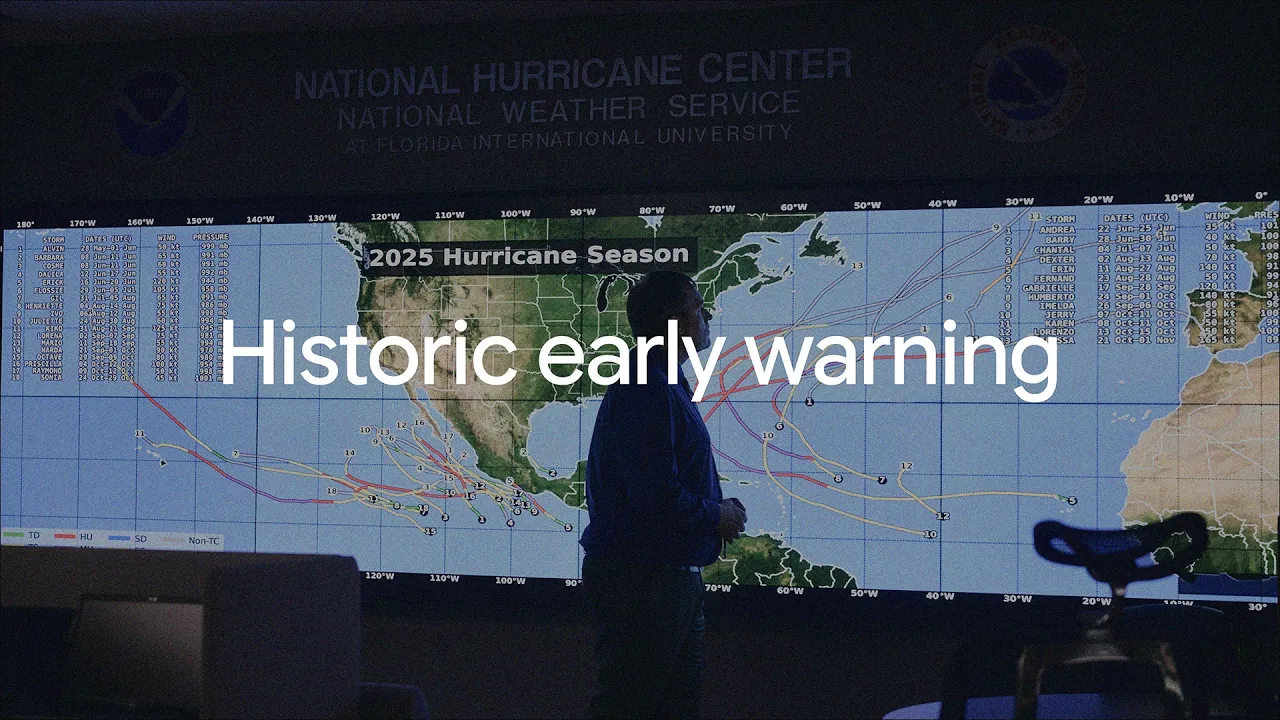
Watch the film
Predicting a historic storm earlier with WeatherNext - YouTube
Tap to unmute
Predicting a historic storm earlier with WeatherNextGoogle DeepMind

Google DeepMind900K subscribers
Improving core capabilities in Gemini
We keep advancing foundational research for generative AI. In collaboration with Google DeepMind, our work in areas spanning factuality, multilinguality and efficiency helps to advance Gemini model quality and performance, and expand global access to our products, to better meet the needs of users.
Our research on LLM factuality goes back to pioneering research onevaluating factual consistencyin 2021 and an earlybenchmarkin 2022. We continue to push Gemini and AI Mode forward, and publish cutting edge research to help the entire community provide factual information. We’ve publishedFACTSandextended itto allow robust benchmarking of factuality in LLMs, and techniques to improve factuality, includingtext-to-image,video generation,long-contextandexpressions of uncertainty.
At I/O, we saw that information journeys are becoming increasingly complex, where people engage in longer conversations to obtain what they need. This creates several challenges for LLMs, including being able to reason and analyze more relevant information in the context window, adhering to constraints that appeared early in the conversation, and using longer reinforcement learning trajectories. Google Research has pioneered work on all these challenges, and these advances fuel our Gemini models.
The newAsk Mapsfeature also allows people to ask complex, longer questions in Google Maps. We partnered with Ask Maps to upgrade its evaluation framework and redefine how map helpfulness is measured. By pinpointing complex edge cases involving model reasoning and tool execution, this collaboration established a vital feedback loop — critical for continuous improvement of Ask Maps' performance. We also drove research to improve the quality ofAsk YouTube, a new feature which helps users find videos and information easily.
Generative AI is making tools and products far more accessible, and allowing technologies to finally meet users where they are. We’ve advanced multilinguality and localization capabilities for Gemini, including the publication of abenchmarkwhich shows how LLMs operate in different languages, and indifferent locations,andopen sourcing data in African languages, developed with the community. Our efforts helped enable the expansion of Gemini to more than 70 languages across more than 230 countries. This makes Gemini the most widely available AI assistant in the world.
Google builds its infrastructure to achieve low latency and high throughput, so that we can serve the needs of users, developers and enterprises around the world. Our research teams developed new techniques building onspeculative decoding— includingblock verificationand tree-structured drafting, which intelligently explores multiple candidate continuations at once and accepts more tokens per step. Our implementation is highly optimized for Google's TPU architecture, maximizing hardware utilization to deliver substantially faster responses with no loss in quality. This work enabled the current speed ofGemini 3.5 Flash, with the same models also powering Antigravity and AI Studio.
Creating more engaging generative experiences
Ourresearchintogenerative UIlaid the foundations for newly announced immersive experiences in Search and in Gemini app. In Search,new generative UI featureswill be available for everyone this Summer. Search can build the ideal response, in the right format for the question, giving users custom experiences including simulations, graphs, trackers and dashboards. And on Gemini, users will see interactive images, timelines and embedded videos. This is now rolling out globally, with the resulting experience feeling more fluid and natural.
play silent looping videopause silent looping video
unmute videomute video
As AI opens the door to new creative possibilities, users are looking for compelling, high-quality generated videos and images. Our research teams collaborated closely with Google DeepMind to help improveGemini Omni, Google’s new model for creating anything from any input, starting with video. We helped improve the quality of the storytelling component of generated video clips, to make them more interesting and engaging, with a particular focus on improving the quality of human expressions in generated clips.
New era in developer productivity
Google Antigravity 2.0, our improved agentic development platform, was launched at I/O last week. It allows users to manage multiple local agents in parallel and automate tasks. Our research teams collaborated with teams across Google to introduce /teamwork-previewagentsin Antigravity, showing how agents on top of the new Flash model can perform complex long-horizon software and ML engineering tasks. This heralds a new era in developer productivity and collapses multi-day engineering efforts into hours. The /teamwork-preview command workflow invokes an agent that refines the user prompt, and then, following user approval, an orchestrator takes over spawning dozens of specialized sub-agents to write, test, and debug code autonomously over extended, long-running sessions. At I/O, we demonstrated how this multi-agent system can build afunctional Operating System from scratch, with an autonomous team of agents writing every line of code from the scheduler to the memory management to the file system. Other demos include implementing AlphaZero paper and building a competitive Go player via self-play.
play silent looping videopause silent looping video
unmute videomute video
Open-sourcesoftware and open access datasets are drivers of modern science. They are key for powering the next generation of pioneering research and products. With open models like MedGemma and open datasets like Groundsource, mentioned above, along with our tools for genomics, neuroscience and more, we ensure that innovation is a catalyst for worldwide progress. In April, Google open-sourcedGemma V4— our most advanced open model yet, purpose-built for reasoning, coding, and agentic workflows. At I/O, it wasannouncedthat Gemma V4 surpassed 100 million downloads in just one month. Our research teams launched architecture changes and training strategies, delivering higher model quality while maintaining the same efficient footprint. This means developers can run more sophisticated, autonomous agentic loops without requiring heavier compute resources.
Innovating new privacy and data protection technologies
In a world where agents can shop and make payments on your behalf and smart glasses can see and guide you everywhere you go, earning and maintaining user trust is paramount. As AI becomes more capable, privacy and data protection are a top priority. Over the years, we’ve developed privacy-preserving technology (PPT) to keep user data safe. PPT can help drive insights from aggregate, anonymized data to improve applications, while providing strong guarantees that individual privacy is protected. For example, we partnered with Google Search to produce privacy-preservinginsightson AI Mode one-year usage, shared last week. Recent privacy innovations include privacy-preserving aggregate insight into how people usechatbotsandon-device AI, as well as improved fundamentals ofdifferential privacy for machine learning,LLMs,partition selection, andsynthetic datageneration.
Alongside these data protections, we are leveraging our innovations in advanced risk management reasoning, bringing them to Gemini models to help secure the AI ecosystem, hardening our AI systems and making them more resilient to emergent risks and vulnerabilities.
Leading the charge on quantum computing
We continue making progress on ourquantum computing roadmap, bringing us closer to real-world applications of quantum computing.
We have pioneered the development of superconducting quantum bits (qubits), achieving milestones likeerror correctionandverifiable quantum advantage. Aspublishedin _Nature_, with our Willow chip, we demonstrated the first-ever algorithm in history to achieve verifiable quantum advantage, running theout-of-order time correlator(OTOC) algorithm, which we callQuantum Echoes. It runs 13,000 times faster on Willow than the best classical algorithm on one of the world’s fastest supercomputers. Earlier this year, we expanded our world-leading quantum computing research to includeneutral atom quantum computing, which uses individual atoms as qubits, alongside superconducting qubits. By investing in both, we can cross-pollinate research and engineering breakthroughs.
On stage at I/O, James Manyika and Hartmut Nevenspokeabout the intersection between quantum computing and AI. These are highly complementary technologies. AI is already accelerating progress in quantum computing on multiple fronts, from chip design to bettererror correction. They also discussed the significant potential for quantum computing to make AI more effective in the real world, as it can probe the quantum mechanics of how nature operates at a fundamental level more closely and accurately than classical computation can.
Last week, we launched theResearch Program at the Intersection of Life Sciences & Quantum AI(REPLIQA), an initiative committing $10 million to five universities to apply advanced quantum science and AI to the life sciences, to improve human outcomes.

Conclusion
The breakthroughs shared at I/O reflect a bold new agentic era of innovation. Many of these advancements demonstrate the power of the magic cycle fromresearch to reality, driving to make the impossible, possible. With AI advancements the magic cycle is accelerating, enabling research on bigger questions, with faster and greater impact on products, science and society.
With thanks to the many teams and collaborators who have contributed to this blog and to the work represented here.
- Labels:
- General Science
Quick links
- Share
- [Share on Twitter](https://twitter.com/intent/tweet?text=https%3A//research.google/blog/a-new-era-of-innovation-google-research-at-io-2026/ "Share on Twitter")
- [Share on Facebook](https://www.facebook.com/sharer/sharer.php?u=https%3A//research.google/blog/a-new-era-of-innovation-google-research-at-io-2026/ "Share on Facebook")
- [Share on LinkedIn](https://www.linkedin.com/shareArticle?url=https%3A//research.google/blog/a-new-era-of-innovation-google-research-at-io-2026/&mini=true "Share on LinkedIn")
- [Send via Email](mailto:name@example.com?subject=Check%20out%20this%20site&body=Check%20out%20https%3A//research.google/blog/a-new-era-of-innovation-google-research-at-io-2026/ "Send via Email")
- Copy link
×
Other posts of interest
- 
- 
- 
×❮❯



×
来源地区
United States
热度分
76
分类
研究进展
语言
en