
A Gaming GPU Helps Crack the Code on a Thousand-Year Cultural Conversation

Summary
Ceramics — the humble mix of earth, fire and artistry — have been part of a global conversation for millennia. From Tang Dynasty trade routes to Renaissance palaces, from museum vitrines to high-stakes auction floors, they’ve carried culture across borders, ev...
Original Article
Captured source content or English translation, normalized into this reading format.

Ceramics — the humble mix of earth, fire and artistry — have been part of a global conversation for millennia.
From Tang Dynasty trade routes to Renaissance palaces, from museum vitrines to high-stakes auction floors, they’ve carried culture across borders, evolving into status symbols, commodities and pieces of contested history. Their value has been shaped by aesthetics and economics, empire and, now, technology.
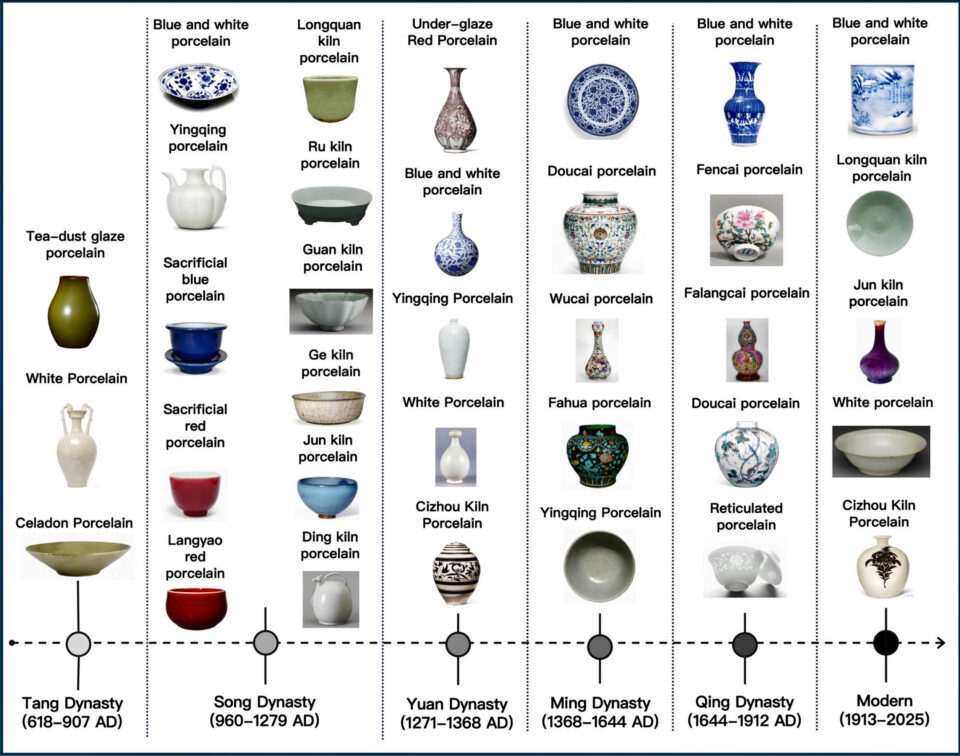This figure visualizes 20 representative Chinese ceramic craftsmanship styles across seven historical periods, ranging from the Tang Dynasty (618–907 AD) to the Modern era (1913–2025). These styles, including kiln-specific categories and decorative techniques, were selected for their historical significance and visual distinctiveness for the AI’s training dataset. Courtesy of Yanfeng Hu, Siqi Wu, Zhuoran Ma and Si Cheng.
In a lab at University Putra Malaysia, that legacy meets silicon.Researchers there, alongside colleagues at UNSW Sydney, have built an AI system that can classify Chinese ceramics and predict their value with uncanny precision. The tool uses deep learning to analyze decorative motifs, shapes and kiln-specific craftsmanship. It predicts price categories based on real auction data from institutions like Sotheby’s and Christie’s, achieving test accuracy as high as 99%.
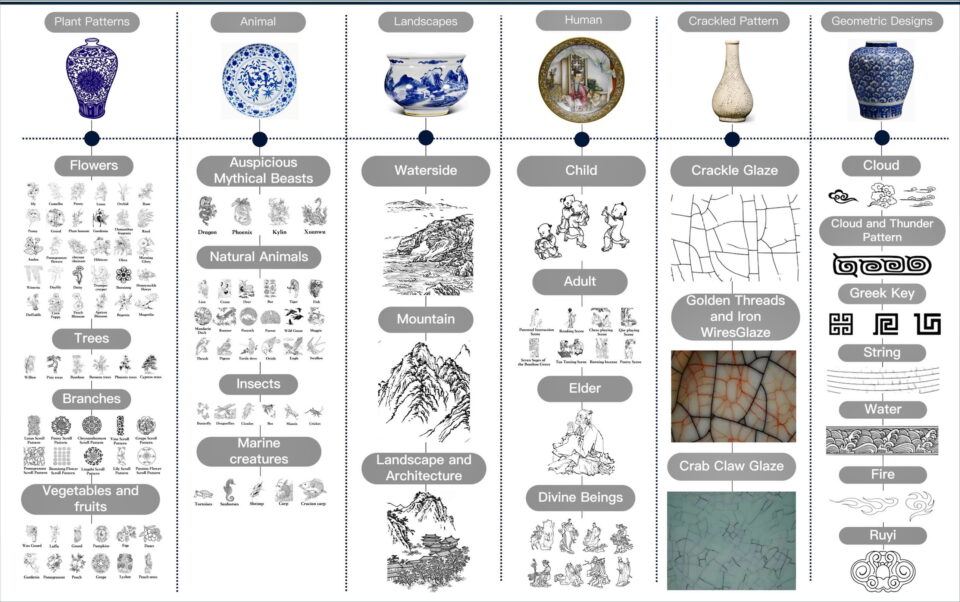Beyond form, the AI also analyzes the intricate decorative patterns found on Chinese ceramics, which are organized into six major categories: plant patterns, animal motifs, landscapes, human figures, crackled glaze patterns and geometric designs. The system annotates images at the category level based on the most visually dominant pattern types. Courtesy of Yanfeng Hu, Siqi Wu, Zhuoran Ma, and Si Cheng.
It’s all powered by an NVIDIA GeForce RTX 3090, a consumer-grade GPU beloved by gamers, explains Siqi Wu, one of the researchers behind the project. Not a data center, not specialized industrial hardware, just the same chip pushing frame rates for gamers enjoying _Cyberpunk 2077_ and _Alan Wake 2_ across the world.
The motivation is as old as the trade routes those ceramics once traveled: access, but in this case, access to expertise rather than material goods.
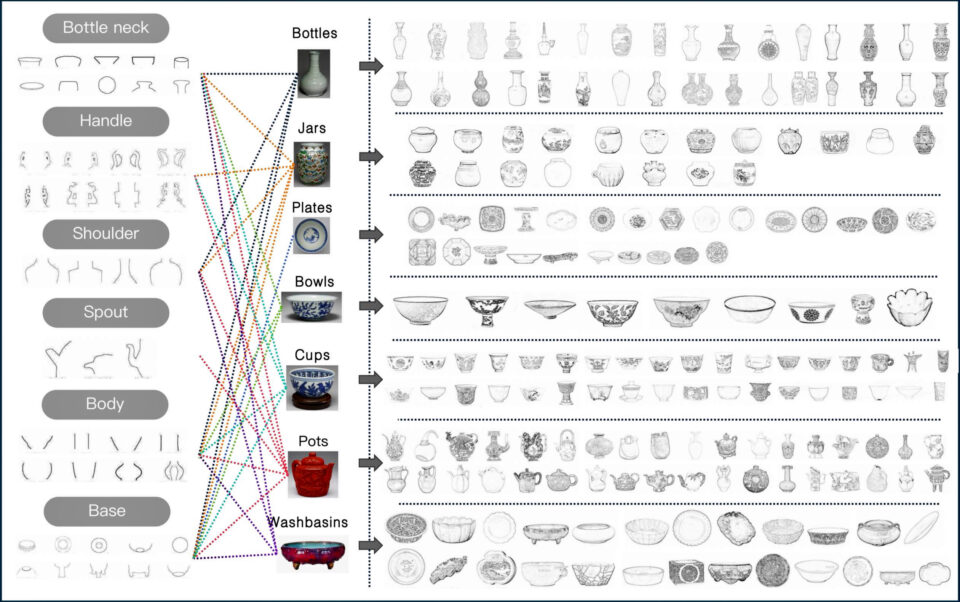The AI system employs a typological classification system for ceramic vessel shapes, based on modular morphological parts like the bottle neck, handle, shoulder, spout, body and base. This approach allows for detailed analysis and classification of shapes such as bottles, jars, plates, bowls, cups, pots and washbasins. Courtesy of Yanfeng Hu, Siqi Wu, Zhuoran Ma and Si Cheng.
“Artifact pricing and dating still heavily rely on expert judgment,” Wu said. That expertise remains elusive for younger collectors, smaller institutions and digital archive projects. Wu’s team aims to change that by making cultural appraisal more objective, scalable and accessible to a wider audience.
It doesn’t stop at classification. The system pairs its YOLOv11-based detection model with an algorithm that learned market value directly from years of real-world auction results. In one test, the AI assessed a Ming Dynasty artifact at roughly 30% below its final hammer price. It’s a reminder that even in an industry steeped in tradition, algorithms can offer new perspectives.
Those perspectives don’t just quantify heritage, they extend the conversation. The team is already exploring AI for other forms of cultural visual heritage, from Cantonese opera costumes to historical murals.
For now, a graphics card built for gaming is parsing centuries of craftsmanship and entering one of the world’s oldest and most global debates: what makes something valuable?
- Categories:
- Deep Learning
Related News

How NVIDIA’s Inference Software Stack Powers the Lowest Token Cost
Jun 30, 2026

NVIDIA and AWS Collaborate to Bring AI to Production at Scale
Jun 23, 2026

How Businesses Are Building Specialized AI They Can Trust
Jun 23, 2026

NVIDIA Powers Over 400 of the World’s 500 Fastest Supercomputers
Jun 23, 2026
Follow Us
'/%3e %3cpath id='NVIDIA' d='M463.9,151.934v13.127h3.707V151.934Zm-29.164-.018v13.145h3.74v-10.2l2.918.01a2.674,2.674,0,0,1,2.086.724c.586.625.826,1.632.826,3.476v5.995h3.624V157.8c0-5.183-3.3-5.882-6.536-5.882Zm35.134.018v13.127h6.013c3.2,0,4.249-.533,5.38-1.727a7.352,7.352,0,0,0,1.316-4.692,7.789,7.789,0,0,0-1.2-4.516c-1.373-1.833-3.352-2.191-6.306-2.191Zm3.677,2.858h1.594c2.312,0,3.808,1.039,3.808,3.733s-1.5,3.734-3.808,3.734h-1.594Zm-14.992-2.858-3.094,10.4-2.965-10.4h-4l4.234,13.127h5.343l4.267-13.127Zm25.749,13.127h3.708V151.935h-3.709ZM494.7,151.939l-5.177,13.117h3.656l.819-2.318h6.126l.775,2.318h3.969l-5.216-13.118Zm2.407,2.393,2.246,6.145h-4.562Z' transform='translate(-399.551 -148.155)'/%3e %3cpath id='Eye_Mark' data-name='Eye Mark' d='M129.832,124.085v-1.807c.175-.013.353-.022.533-.028,4.941-.155,8.183,4.246,8.183,4.246s-3.5,4.863-7.255,4.863a4.553,4.553,0,0,1-1.461-.234v-5.478c1.924.232,2.31,1.082,3.467,3.01l2.572-2.169a6.81,6.81,0,0,0-5.042-2.462,9.328,9.328,0,0,0-1,.059m0-5.968v2.7c.177-.014.355-.025.533-.032,6.871-.232,11.348,5.635,11.348,5.635s-5.142,6.253-10.5,6.253a7.906,7.906,0,0,1-1.383-.122v1.668a9.1,9.1,0,0,0,1.151.075c4.985,0,8.59-2.546,12.081-5.559.578.463,2.948,1.591,3.435,2.085-3.319,2.778-11.055,5.018-15.44,5.018-.423,0-.829-.026-1.228-.064v2.344h18.947v-20Zm0,13.009v1.424c-4.611-.822-5.89-5.615-5.89-5.615a9.967,9.967,0,0,1,5.89-2.85v1.563h-.007a4.424,4.424,0,0,0-3.437,1.571s.845,3.035,3.444,3.908m-8.189-4.4a11.419,11.419,0,0,1,8.189-4.449v-1.463c-6.043.485-11.277,5.6-11.277,5.6s2.964,8.569,11.277,9.354v-1.555C123.731,133.451,121.643,126.728,121.643,126.728Z' transform='translate(-118.555 -118.117)' fill='%23000000'/%3e %3c/svg%3e)United States
- Privacy Policy
- Your Privacy Choices
- Terms of Service
- Accessibility
- Corporate Policies
- Product Security
- Contact
Copyright © 2026 NVIDIA Corporation
Share on Mastodon
Enter your Mastodon instance URL (optional)Share
Region
United States
Heat Score
73
Category
Compute & Chips
Language
en